Wednesday, October 30, 2013

Bottom-feeding behavior of Humpback whales

Known for their interesting ways of capturing prey, the humpback whales have recently been discovered to have found a new method of feeding itself; bottom feeding (specifically in the Southern Gulf).

"Humpbacks have not been known as bottom-feeders, yet this i their dominant feeding mode in this region." Says Colin Ware, a professor at the University of New Hampshire, "You've got this prominent species and until now, nobody knew how they were feeding." Ware and his colleagues have gathered data from 52 humpbacks in the region.

To track the movements of the whales from below the surface, scientists have put recording tags on the whale's backs. Ware also developed a software called "TrackPlot" to translate the tags on the humpbacks. This allowed for Ware and his colleagues to discover three different ways the humpbacks were bottom-feeding: simple side rolls, side roll inversions, and repetitive scooping.


Article:http://www.sciencedaily.com/releases/2013/10/131030125324.htm
Picture: http://theterramarproject.org/thedailycatch/wp-content/uploads/2013/09/terra-mar-humpback-under-surface-600x320.jpg

Saturday, October 26, 2013

Reading Ancient Climate from Plankton Shells

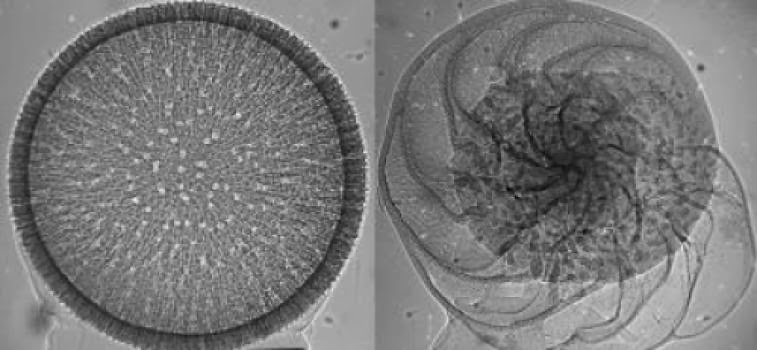
      Scientists have viewed plankton shells to chart climate changes in sea temperatures. This information could provide the means for scientists to scale temperature from millions of years ago by showing us things like tree rings. Before we used plankton to chart changes, we used ice from the poles, which trap bubbles of ancient air. "The oldest Antarctic ice core records date back to around 800,000 years ago." Says ScienceDaily.com.
   
      Scientists have learned that the plankton that grow in warmer climate have more traces of ancient atoms. Another way we can read ancient climates is by looking at the shells of dead plankton who have fallen to the ocean floor. Scientists can recover ocean floor sediments which are preserved in the shells. Researchers at the University of Cambridge have discovered magnesium in the shells of plankton, which helps us tell how warmer waters could effect the shells.


Article: http://www.sciencedaily.com/release2013/10/131
Picture: http://www.sciencedaily.com/release025123155.htm

Sunday, October 13, 2013

Sequence Stratigraphy

10/13/13

Sequence Stratigraphy has recently been added as a branch of geology and its purpose is to connect pre-historic sea level changes to sedimentary deposits. It is called 'sequence' stratigraphy because it mentions cyclic sedimentary deposits.

Sedimentary deposits are significant because they include a lot of important minerals for industries such as petroleum, gas, iron, aluminum and coal. The deposits are also used to get gravel, limestone, chalk, sand, clay, and slate.


'Stratigraphy' literally means the study of rock strata and their relationship to the geological time scale.

It also talks about the transferring and age sediments and gives us a good idea about how we get sediments.

This is important because sea levels constantly changing over time and are rising and if they continue to do so it can be very dangerous to several cities and corporations that depend on the sea.


Article 1: http://www.sciencedaily.com/articles/s/sequence_stratigraphy.htm
Article 2: http://encyclopedia2.thefreedictionary.com/Sedimentary+Deposits
Picture 1: http://strata.uga.edu/sequence/type1Shelf.gif
Picture 2: http://www.uib.no/imagearchive/produktbilde_Sequence_strat2.jpg

Sunday, October 6, 2013

Warmer Oceans Could Raise Mercury Levels in Fish

10/6/13

Should the temperature of the ocean's surface rise, fish would be accumulating more mercury. This would be horrible for sea food fanatics. Researchers have not known how global warming can effect rising mercury levels in aquatic life until now, nor has there been any experiments on the matter.
The mercury can be released into oceans and streams from industrial pollution. This can be converted into methylmercury in the water.
Scientists have examined killifish in varying temperatures in salt water marshes and in the lab. The fish in the lab ate mercury-enriched food whereas those in the salt water marshes ate natural food sources such as worms and insects.
Results showed that the fish in higher temperature waters consumed more food but grew less and had a higher measure of methylmercury in their tissues.


There is a major concern of eating seafood while pregnant but studies actually show that children of the 90's whose parents have eaten seafood while pregnant have higher IQ's and better eyesight.

Website: http://www.sciencedaily.com/releases/2013/09/130930211701.htm

Picture 1:http://upload.wikimedia.org/wikipedia/commons/thumb/c/c5/MercuryFoodChain-01.png/515px-MercuryFoodChain-01.png

Picture 2: http://www.sciencedaily.com/releases/2013/10/131003162953.htm

Sunday, September 29, 2013

Sedimentary Rock

9/28/13
Sedimentary rocks are one of the three main rocks groups including igneous and metamorphic rocks.The Sedimentary rocks are formed in four different ways: by the deposition of the weathered remains of other rocks, by the accumulation and consolidation of other sediments, by the deposition of the results of biogenic activity, and by precipitation from solution. 

Clastic sedimentary rocks are formed by erosion by friction of waves, and by transportation where the sediment is carried along by a current. The rock is then formed by disposition and compacting where the sediment is squashed together to form a rock.
The rocks can also be formed by overburden pressure as particles of sediment are accumulated from air, ice, or water sources carrying the particles.

Chalk, limestone, sandstone, clay, and shale are a few types of common Sedimentary rocks. 


Sedimentary rocks cover 75% of the Earth's surface and around 8% of the total volume of the crust. They form a bedding (also known as "strata") just above igneous rocks which cover 90-95% of the earths crust below the Sedimentary rocks. Metamorphic rocks also make up part of the Earth's crust.

Sedimentary rocks are used for coal, fossil fuels, drinking water, and ores. The rocks are also an asset to  roads, houses, canals, and tunnels. 

Website: http://www.sciencedaily.com/articles/s/sedimentary_rock.htm

Picture 1:http://blessan.files.wordpress.com/2010/03/sedimentary-rocks1.jpg

Picture 2: http://upload.wikimedia.org/wikipedia/commons/thumb/7/75/Helgoland_Lummenfelsen_22067.JPG/500px-Helgoland_Lummenfelsen_22067.JPG

Sunday, September 22, 2013

Estuaries

What is an Estuary? 

An Estuary is a partially-enclosed body of water that has an opening 
to the open ocean with streams flowing into it. Estuaries can help create 
fresh water by mixing it with the salt water from the ocean and the fresh 
water from the streams and rivers.

However, an Estuary needs some type of tide to maintain 
a connection between the multiple water sources. If the waters are non-
tital, the rivers will form a delta. 


The world's largest Estuary is the Gulf of St. Lawrence, located 
in eastern Canada.  


"Estuarine environments are among the most productive on earth, creating more organic matter each year than comparably-sized areas of forest, grassland, or agricultural land. The tidal, sheltered waters of estuaries also support unique communities of plants and animals especially adapted for life at the margin of the sea." (EPA.gov)

Estuaries are very diverse; they contain shallow waters,
 fresh and salt marshes, swamps, mud and sand flats, rocky shores, oyster reefs, mangrove forests, river deltas, tidal pools, and seagrasses. 
Estuaries are popular places for recreation and many types of scientific research. 
Migratory birds often seek refuge during long journeys in estuarine environments.

Article 1: http://www.sciencedaily.com/articles/e/estuary.htm

Article 2: http://water.epa.gov/type/oceb/nep/about.cfm

Picture 1: http://ccma.nos.noaa.gov/_images/estuary.jpg

Picture 2: http://b.static.trunity.net/images/209830/500x0/scale/Gulf_of_St._Lawrence.png


Sunday, September 15, 2013

Drilling to the Earth's Mantle through Oceanic Crust

Mike Del Priore
9/15/13


Drilling through the Earth's crust


            Deep-water drilling technology is being developed by The Integrated Ocean Drilling Program (IODP) and AGR drilling services. Why? According to Geology.com, "Drilled cores from the mantle could provide scientists with answers to questions about the structure, composition, mineralogy, and in situ physical properties of oceanic crust and the geological nature of the seismic Moho."

            Primarily, such drilling was only used for shallow-water oil and gas recovery. But now that IODP is aided by AGR, they are now able to expand their drilling to lower depths of the ocean. 

          "The 'riserless mud recovery technology' (RMRT), owned by AGR, is expected to operate in hyper-deepwater depths greater than 12,000 feet." (Geology.com). A major benefactor for this project is DeepStar Consortium, an industry that supports deepwater research and technology. 

           Previous to this project, on an IODP expedition, scientists encountered mantle depths while looking into seafloor spreading rates. The drilling reached volcanic rock and a fossil magma chamber deep beneath the ocean floor.

Website:   http://geology.com/press-release/drilling-to-mantle/
Picture:     http://geology.com/press-release/drilling-to-mantle/riserless-mud-recovery-lg.jpg